
A paramedic in Hartford who closes on a first house late this month could leave the table owing $25,000 less than the money the deal actually required — and never pay a dollar of it back if she stays ten years. A paramedic doing the identical job in Columbus gets no check at all, just a slightly cheaper interest rate. Same badge, same mortgage, wildly different help, decided entirely by state lines.
Connecticut turns its new program on November 16, 2026, which makes this a good week to compare what first responders can actually claim across the country.
What Connecticut is handing police, firefighters and EMS
The state's new benefit is called First Responders' Time to Own, run by the Connecticut Housing Finance Authority. It provides up to $25,000 in forgivable down payment and closing-cost help at 0% interest, plus a 0.125 percentage-point cut on the first mortgage rate. The loan forgives itself at 10% a year and disappears completely on the tenth anniversary of closing, the same structure as CHFA's regular Time to Own loan.
Two things make the first-responder version easier to reach. There is no area median income cap, and the usual three-year Connecticut residency rule is waived. You need at least two years of service as a certified officer, a career or volunteer firefighter, or licensed EMS, and you have to buy in the community you serve and live there. That last clause is the catch: it ties the money to where you work, not where you want to live.
The same job, a different check in Texas, Georgia, Florida and Ohio
Four other states already offer first-responder homebuying help, and no two use the same math. Texas pays a percentage of your loan. Georgia and Florida lend you a lump sum that sleeps until you sell. Ohio hands over no cash and shaves your rate instead.
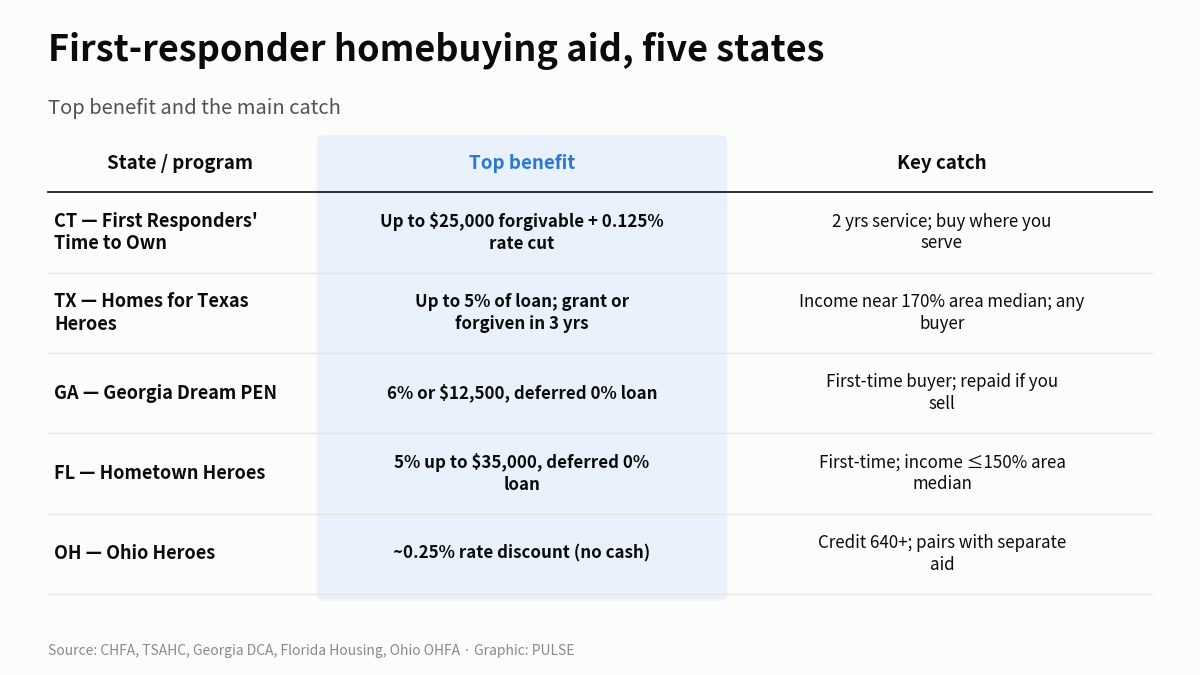
| State / program | Top benefit | Key catch |
|---|---|---|
| CT — First Responders' Time to Own | Up to $25,000 forgivable, plus 0.125% rate cut | 2 yrs service; buy where you serve |
| TX — Homes for Texas Heroes | Up to 5% of loan; grant or forgiven in 3 yrs | Income cap near 170% of area median; any buyer |
| GA — Georgia Dream PEN | 6% or $12,500, deferred 0% loan | First-time buyer; repaid if you sell or refi |
| FL — Hometown Heroes | 5% up to $35,000, deferred 0% loan | First-time buyer; income at or under 150% of area median |
| OH — Ohio Heroes | About 0.25% rate discount (no cash) | Credit score 640+; pairs with separate aid |
Texas runs its help through the Texas State Affordable Housing Corporation. Homes for Texas Heroes gives police, corrections officers, firefighters, EMS, teachers and veterans down payment money worth up to 5% of the loan, delivered as either a grant that is never repaid or a second lien forgiven after three years. You do not have to be a first-time buyer.
Georgia's version sits inside the Georgia Dream program at the Department of Community Affairs. Its PEN track — Protectors, Educators and Nurses — offers 6% of the price or $12,500, whichever is less, and "protectors" means peace officers, firefighters, EMTs and paramedics. Florida's Hometown Heroes, administered by Florida Housing, is a broader workforce program that includes first responders and pays 5% of the loan up to $35,000. Ohio keeps it simple and cheap: the Ohio Heroes program from the Ohio Housing Finance Agency cuts the mortgage rate by about a quarter point for first responders, teachers, nurses and veterans, with no grant attached.
A grant, a sleeping loan, or a cheaper rate
The headline dollar figure hides the part that decides your real benefit: whether you ever give the money back. Connecticut and the grant option in Texas are the cleanest — stay long enough and the help is simply yours. Georgia and Florida structure their aid as a zero-interest second mortgage with no monthly payment that comes due when you sell, refinance or move out. You keep the house, but the balance follows you to the closing table on the way out.
Ohio's quarter-point rate cut looks small next to a $25,000 check. Over a 30-year loan it is not. On a mid-sized mortgage the lifetime interest savings can run well past $10,000, and unlike a forgivable loan there is no clock to outlast and nothing to repay if you move in year two.
Who counts as a first responder, and the catches that disqualify people
Eligibility is where good intentions meet fine print. All five states cover sworn police, firefighters and licensed EMS, and Connecticut explicitly counts volunteer firefighters. After that the rules diverge.
- Connecticut and Florida require that the home be your primary residence; Connecticut adds that it must be in the town you serve.
- Georgia and Florida generally require that you be a first-time buyer, meaning no ownership in the past three years. Texas drops that rule for its down payment help.
- Income caps swing hard. Florida uses 150% of area median income; Texas runs near 170% of area median family income; Connecticut sets no area-based cap at all for first responders.
- Credit matters. Florida and Ohio generally want a 640 score, and Texas sets a 620 floor on its forgivable option.
Funding matters too. These pools are finite and move first-come, first-served. Connecticut's broader Time to Own fund had about $10.6 million left as of November 9, and Florida's program runs in annual tranches that can empty before the year does.
What to check before you count on any of this
Start with your own agency page, not a lender's flyer, because the numbers above change when legislatures and housing authorities refresh them. Pull your county's income limit and confirm it against your household total before you fall in love with a listing. Ask your loan officer which lenders are approved to originate the state loan, since not every bank participates. If you are in Connecticut, confirm the home sits inside the jurisdiction you serve, because that single rule has no workaround. And if you are weighing a grant against a deferred second mortgage, do the math on how long you plan to stay — a forgivable loan you leave in year two can cost you the whole balance at resale.
How we checked this
We read the Connecticut Housing Finance Authority's First Responders' Time to Own and Time to Own program pages on November 15, 2026, and confirmed the $25,000 forgivable amount, the 0.125 percentage-point rate cut, the ten-year forgiveness schedule, the two-year service rule and the community-of-service requirement there; the November 16 launch date is confirmed through NBC Connecticut. We confirmed the Texas figures on the Texas State Affordable Housing Corporation's own knowledge base. We could not load the official Florida Housing, Georgia Department of Community Affairs or Ohio Housing Finance Agency pages from our connection on the check date; those states' figures come from the agencies' published program terms as reported by the sources linked above and an official Florida Housing occupations document, and you should verify them on each agency's site before relying on them. Dollar amounts, income caps and funding levels change without notice. Spot an error? Write to connect@blinkhub.net.
Cover photo: Thirdman / Pexels