If you are on Medicaid, between 19 and 64, and covered through the expansion that your state opened to low-income adults, a new work requirement now applies to you. That part is settled. What is not settled is the date your state will act on it — and that date is no longer the same everywhere.
On November 13, 2026, the Centers for Medicare & Medicaid Services told states they may hold off on cutting anyone's coverage over the new rule until as late as June 30, 2027. The federal start date on the calendar did not move. The moment your state can actually take your coverage away did.
The January 1 date is real, but enforcement is a separate switch
The work requirement itself comes from the 2025 budget law, the One Big Beautiful Bill Act, and the rule carrying it out. States must begin applying it on January 1, 2027, unless they chose an earlier date. That is the statutory floor.
The new piece is what CMS calls a hold harmless period. It is optional. A state that takes it will still check whether you meet the requirement or qualify for an exclusion, but it will not deny your application or drop your coverage solely because you failed to meet the hours — not until the state ends its hold harmless window, and no later than June 30, 2027.
Dan Brillman, who runs the federal Center for Medicaid and CHIP Services, framed the extra time around paperwork. "If the state can use data to show that someone is working or qualifies for an exclusion, that person should not have to track down paperwork to prove it," he said in the announcement. A state can take a shorter window, or none at all.
What the 80-hour rule actually asks of you
The requirement lands on non-pregnant adults ages 19 to 64 in the Medicaid expansion group who are not on Medicare. Each month, you need to show 80 hours of work, community service, a qualifying work program, or half-time schooling — or a mix adding up to 80. Earning at least 80 times the federal minimum wage, about $580 a month in 2026, also counts.
Several groups are excluded. The federal rule names pregnant people, those who are medically frail, parents or caretakers of a child under 14, American Indians and Alaska Natives, and veterans with a total disability rating, among others. States may also offer short-term hardship exceptions, such as areas with unemployment at or above 8 percent or a declared emergency.
Four states already started, months before the deadline
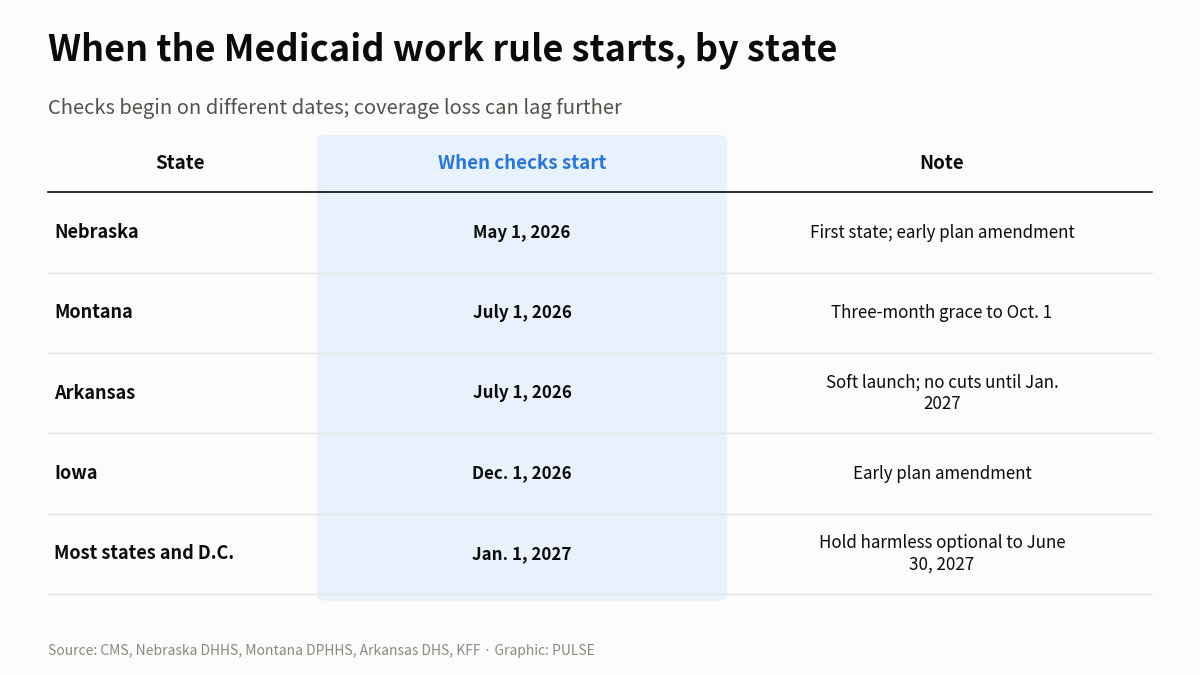
Some states did not wait. Nebraska went first, beginning its checks on May 1, 2026, through a state plan amendment. Montana turned its community engagement rules on July 1, 2026, with a three-month grace stretch into October. Arkansas launched the same day but called it a soft launch: it began testing who meets the rule in its ARHOME program, with no one losing coverage until January 2027. Iowa set its start for December 1, 2026.
Georgia is a separate case. Its existing Pathways waiver runs through the end of 2026, after which it folds into the federal requirement.
For most of the roughly 40 states and the District of Columbia that expanded Medicaid, nothing happens on your coverage before January 1, 2027 — and if your state adopts the hold harmless period, the first month you could lose coverage over the hours could slide to as late as July 2027.
| State | When checks start | Note |
|---|---|---|
| Nebraska | May 1, 2026 | First state; early plan amendment |
| Montana | July 1, 2026 | Three-month grace to Oct. 1 |
| Arkansas | July 1, 2026 | Soft launch; no cuts until Jan. 2027 |
| Iowa | Dec. 1, 2026 | Early plan amendment |
| Most states and D.C. | Jan. 1, 2027 | Hold harmless optional to June 30, 2027 |
Why the same federal rule reaches people on different dates
Even past the start date, the mechanics differ. Most states — about 34 — plan to check your compliance once every six months, when your eligibility is renewed, according to a KFF review of state decisions. Indiana and New Hampshire plan quarterly checks. That means a person in a six-month state whose renewal falls in, say, August might not face a real test until then, while a quarterly state tests sooner.
The hardship cushion varies too. KFF found that 29 states plan at least one optional hardship exception, and most are adopting all four the rule allows. Indiana and Iowa plan none. So two enrollees with identical circumstances — a stretch of unemployment, a medical setback — can land on different sides of the line depending on their state.
What to check before your renewal comes up
Find your renewal date. It is the hinge most states use to apply the rule, so it, not January 1, is the date that matters for you. Then confirm two things with your state Medicaid agency: whether your state is using the hold harmless period, and whether it verifies compliance every six months or more often.
If you already work, go to school, or fit an exclusion such as being a parent of a child under 14, check whether your state can see that from its own data — several agencies say they will match records automatically before asking you for proof. If it cannot, keep pay stubs, enrollment letters, or volunteer records for the lookback months. Watch your state's Medicaid site and your mail through the first half of 2027, because a state can end its hold harmless window early.
How we checked this
We read the CMS press release announcing the hold harmless period (dated November 13, 2026) and the June 2026 interim final rule fact sheet for the 80-hour requirement, exclusions, and the January 1, 2027 start. State start dates came from Nebraska DHHS, Montana DPHHS, the Arkansas DHS announcement, and KFF's tracking of state decisions and 1115 waivers. We checked these pages on November 14, 2026. A direct fetch of the Arkansas DHS page timed out, so its July 1 soft launch is drawn from the agency's published announcement as indexed and from KFF. We could not confirm a complete, state-by-state list of which states will use the hold harmless period: CMS says adoption is optional and states have not all made their choices public, so individual readers should confirm with their own state agency. Where a value could not be verified on an official page, we say so in the text. Spot an error? Write to connect@blinkhub.net.