If you were planning to use a federal rebate to pull out a gas furnace and drop in a heat pump, the deal you read about two years ago is not the deal on offer today. A rule change this spring took fuel switching off the table for the federal appliance rebate in state after state. And in most of the country, including Oregon, the rebate portal still isn't open.
The two programs come from the 2022 Inflation Reduction Act: the Home Efficiency Rebates program, known as HOMES, which pays based on how much energy a whole-home retrofit saves, and the Home Electrification and Appliance Rebates program, known as HEAR, which discounts specific electric equipment for lower-income households. Congress funded them nationally, but each state runs its own version on its own timeline, so the answer to "can I get this?" depends entirely on where you live.
What the federal caps actually allow
Under HEAR, the single largest line item is a heat pump for space heating and cooling, capped at $8,000. A heat pump water heater tops out at $1,750 and a heat pump clothes dryer at $840. No household can draw more than $14,000 in total HEAR money.
Income sets how much of the bill the rebate covers. A household at or below 80 percent of its area median income can have up to 100 percent of project cost covered, up to those caps. A household between 80 and 150 percent of area median income gets up to 50 percent of project cost, but the per-household total cap stays at $14,000, according to the program's income rules. Households above 150 percent are not eligible for HEAR at all. HOMES has no strict income ceiling but pays lower-income homes a larger share.
The rule that cut out gas-to-electric swaps
In Program Notice 26-2, effective May 29, 2026, the Department of Energy rewrote what HEAR will pay for. The notice removes "program allowances for upgrades for fuel-switching," and instead allows rebates "only from existing electric equipment to more efficient electric equipment," per the DOE guidance. In plain terms: if your home is heated by gas, oil, or propane today, HEAR will not pay to replace that system with a heat pump. A home already running electric resistance heat can still upgrade.
The department described the revisions as a move to "advance affordability" and "align requirements more closely with statutory requirements," in its own notice. The change was reported and criticized by clean-energy groups as a reversal of the program's original electrification goal, as Canary Media and the Sierra Club documented. States were given about three months to bring their programs into line.
Oregon's money is approved, but the door is shut until 2027
Oregon is the newest state in the pipeline, with more than $113 million awarded by the federal government for both programs combined. On paper that is a large commitment: the state's own announcement describes HOMES rebates covering 50 to 100 percent of project costs up to $10,000, and HEAR rebates up to $14,000.
None of that is available yet. The Oregon Department of Energy's rebate site states plainly that "no rebates are available at this time," with single-family applications scheduled to open in early 2027, followed later by multifamily and in-store coupons. The state has said federal requirement updates pushed its original spring 2026 target back. So the headline figure is real, and the opening date is not here.
Where you can actually apply right now
The National Association of State Energy Officials tracks launches. As of its September 30, 2026 update, eight states plus the District of Columbia had HOMES open, and 13 states plus D.C. had HEAR open. The HEAR list included Arizona, California, Colorado, Georgia, Indiana, Maine, Michigan, New Mexico, New York, North Carolina, Rhode Island, West Virginia, and Wisconsin.
Being "launched" does not mean the money is still there. California opened early and ran through it fast: the state energy commission reports that single-family HEAR rebates were fully reserved as of August 31, 2026, with only multifamily rebates still open, and its HOMES funds now flowing through a narrower direct-install program for low-income homes. A rebate that is technically live can be effectively closed.
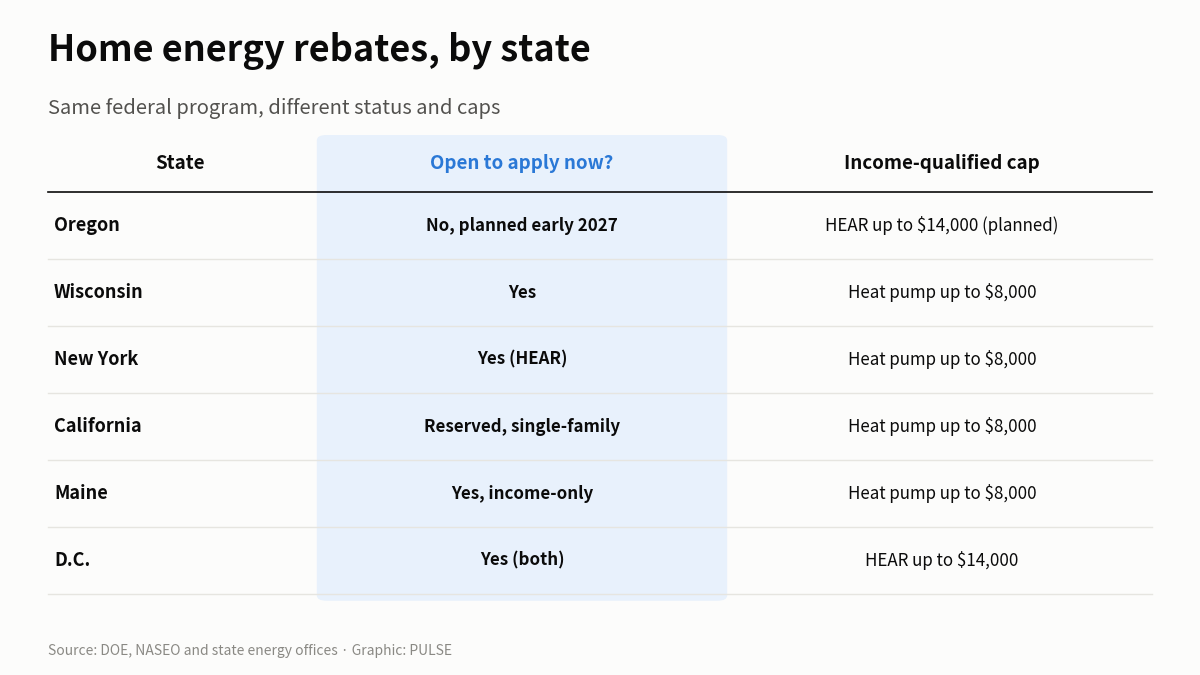
| State | Open to apply now? | Income-qualified cap |
|---|---|---|
| Oregon | No, planned early 2027 | HEAR up to $14,000 (planned) |
| Wisconsin | Yes | Heat pump up to $8,000 |
| New York | Yes (HEAR) | Heat pump up to $8,000 |
| California | Reserved, single-family | Heat pump up to $8,000 |
| Maine | Yes, income-only | Heat pump up to $8,000 |
| D.C. | Yes (both) | HEAR up to $14,000 |
Five states, five different sets of rules
Wisconsin runs HEAR through Focus on Energy. A space-heating heat pump qualifies for up to $8,000, with homes below 80 percent of area median income getting 100 percent of cost up to $14,000 and those between 80 and 150 percent getting 50 percent. As of September 1, 2026, the program stopped accepting retail coupon requests for equipment replacing fossil-fuel appliances, the state's expression of the federal fuel-switching change.
New York launched HEAR in September 2026 through NYSERDA's income-qualified channel, with a heat pump rebate up to $8,000 for households at or below 150 percent of area median income. Maine funnels its federal money through Efficiency Maine, which pays 80 percent of cost up to $8,000 for low-income households and 60 percent up to $6,000 for moderate-income ones, and notes that standard single-family homes outside those income tiers are not eligible for HEAR there.
The District of Columbia is one of the few places running both programs for residents. Its Department of Energy and Environment offers up to $14,000 in combined HEAR rebates and, on the HOMES side, up to $30,000 per unit for projects that cut estimated energy use by 35 percent or more. The same federal program, then, pays an $8,000 heat pump ceiling in Wisconsin and a far larger whole-home retrofit in D.C., because the two programs reward different things.
What to check before you buy anything
Start with your state energy office, not a contractor's flyer, and confirm three things in writing: whether your program is open and still has funds, whether your current heating fuel disqualifies you after the 26-2 change, and which income tier you fall in. If your home runs on gas or oil, assume HEAR will not pay to electrify it unless your state has an exception, and look instead at HOMES, which pays on measured energy savings, or at separate state and utility rebates that can often stack with federal money. If you are in Oregon, there is nothing to apply for yet; watch the state's rebate page for the early-2027 opening and get an energy assessment lined up, since HOMES requires projected savings of at least 20 percent.
How we checked this
We read the Department of Energy's Program Notice 26-2, the NASEO launch tracker dated September 30, 2026, and the official rebate pages of the Oregon Department of Energy, the California Energy Commission, Wisconsin's Focus on Energy, Efficiency Maine, and the District's Department of Energy and Environment, along with NYSERDA program information. All figures were checked on November 13, 2026. We could not retrieve DOE's consumer landing page at energy.gov/save/rebates, which returned an error, so federal caps here come from Program Notice 26-2 and state program pages. Oregon has not published heat-pump-specific amounts, so its row shows the planned HEAR household cap rather than a confirmed heat-pump figure. Per-state heat pump ceilings reflect the $8,000 federal maximum as published by each state; where a value could not be confirmed on an official page we said so. Spot an error? Write to connect@blinkhub.net.
Cover photo: alpha innotec / Pexels