If you ran offshore for red snapper past the nine-mile line this year, how many days you could legally do it came down to one thing: which Gulf state you left from. A Texas angler had 183 days in federal water. A Mississippi angler was finished by late September. Same fish, same water, five different calendars.
Texas shut its 2026 federal season at 11:59 p.m. on Nov. 20, the longest run since the states started setting these dates themselves, the Texas Parks and Wildlife Department said in its closing announcement. "The 2026 federal red snapper season offered nearly six months of red snapper fishing opportunities to the people of Texas," said Robin Riechers, the department's coastal fisheries director. The next state over wrote a very different schedule.
Washington gave up the calendar years ago
It used to be one season for everyone. Through 2017, NOAA Fisheries set a single Gulf-wide recreational season in federal waters, and in some years private anglers got only a handful of days. That changed when the five Gulf states began running their own seasons under federal exempted fishing permits in 2018, an arrangement made permanent for the private-boat sector under a plan called Amendment 50 starting in 2020.
Here is the part that trips people up. Each state now sets one season that covers both its own waters and the federal zone beyond, and each manages to its own slice of the Gulf catch. A longer season in Alabama does not shorten anyone else's. The seasons are independent, which is exactly why they diverge.
What each Gulf state's 2026 season actually looked like
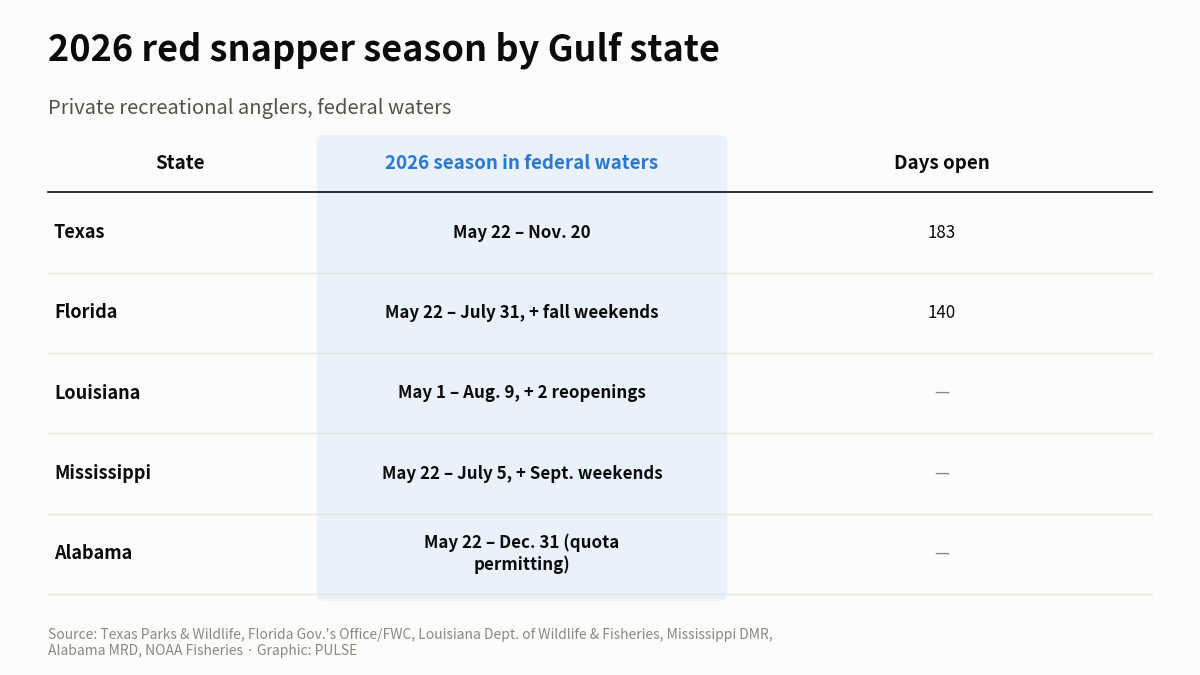
Two states published a clean day count. Texas reported 183 days, May 22 through Nov. 20. Florida's 140-day season, its longest since the state took over, opened May 22, ran through July 31, then reopened on a long string of fall and holiday weekends that stretch to Jan. 4, 2027.
The other three did not run straight through, so there is no single headline number. Louisiana opened earliest, on May 1, and fished seven days a week with a four-fish daily bag until it closed Aug. 9 near its quota, then added two four-day reopenings on Aug. 27 to 30 and Sept. 4 to 7, by the LDWF dates reported in Louisiana Sportsman; that works out to roughly 109 open days. Mississippi ran May 22 to July 5, reopened for Labor Day, then went to weekends only until it closed for the year on Sept. 27 with about 98 percent of its catch used. Alabama opened May 22 seven days a week and, by its rules, stays open until its quota is projected to be met or Dec. 31 arrives, whichever comes first.
| State | 2026 private-rec season in federal waters | Days open |
|---|---|---|
| Texas | May 22 – Nov. 20 | 183 |
| Florida | May 22 – July 31, then fall weekends to Jan. 4 | 140 |
| Louisiana | May 1 – Aug. 9, plus Aug. 27–30 and Sept. 4–7 | — |
| Mississippi | May 22 – July 5, then weekends to Sept. 27 | — |
| Alabama | May 22 – Dec. 31 (quota permitting) | — |
Where a season stopped and restarted or is still open, the table shows an em dash, because no state agency has published one tidy total for it. The approximate counts in the text are our arithmetic from the official open and close dates, not a figure the agencies themselves report.
Why the smallest slice bought the longest season
The sizes of those slices are set by a federal formula, not by each year's fishing. Florida holds about 44.8 percent of the private-angler catch, Alabama about 26.3 percent, Louisiana about 19.1 percent, Texas about 6.2 percent and Mississippi about 3.6 percent, under the allocation NOAA uses.
So how does Texas, with the second-smallest share, fish the longest? Two reasons. Texas keeps its own state waters open all year, so a smaller part of its catch is landed from the federal zone, and managers can spread the federal days out without blowing past the number. The daily bag matters too: Louisiana allowed four fish a day in 2026 while Texas, Mississippi and Alabama allowed two in federal water, so Louisiana anglers spent their pounds faster, fast enough that the state landed 934,367 pounds against an 882,439-pound target.
There is one more reason the pound figures do not line up neatly. Each state counts its catch with its own survey, such as Alabama's Snapper Check and Mississippi's Tails n' Scales, and those counts run on different scales than the federal survey, so a pound in one state's books is not the same as a pound in another's. That is a real part of why Alabama can stay open toward December on a 664,552-pound quota while Mississippi, with a much smaller share, closed in the fall.
What to check before you run offshore
If you fish out of Alabama, the season was still open as this published, running toward Dec. 31 unless the quota is reached first, so look at the state's live Snapper Check updates before you go. Florida's fall and winter weekends run into January, so confirm the exact dates on the state's schedule. And remember the line in the water: in Texas, state waters stay open all year at four fish a day, while the federal zone past nine miles follows the dates above at two fish. Every one of these calendars resets next spring, when each state announces fresh dates, so this year's 183 days guarantees nothing for 2027.
How we checked this
We read the 2026 season notices from the Texas Parks and Wildlife Department, the Florida Governor's Office and Fish and Wildlife Conservation Commission, the Mississippi Department of Marine Resources, the Alabama Marine Resources Division, and the Louisiana Department of Wildlife and Fisheries, along with NOAA Fisheries materials on the federal season and state allocations. Checked Nov. 13, 2026. We could not load the Louisiana department's own red snapper page or Florida's FWC page directly, because both returned access errors, so Louisiana's dates are attributed to LDWF notices as reported by Louisiana Sportsman and Florida's dates come from the Governor's Office release. We could not independently confirm the exact pounds landed in Alabama on our check date, and no state publishes a single day count for a stop-and-start season, which is why three rows show an em dash. Spot an error? Write to connect@blinkhub.net.
Cover photo: Fiifi Boateng / Pexels