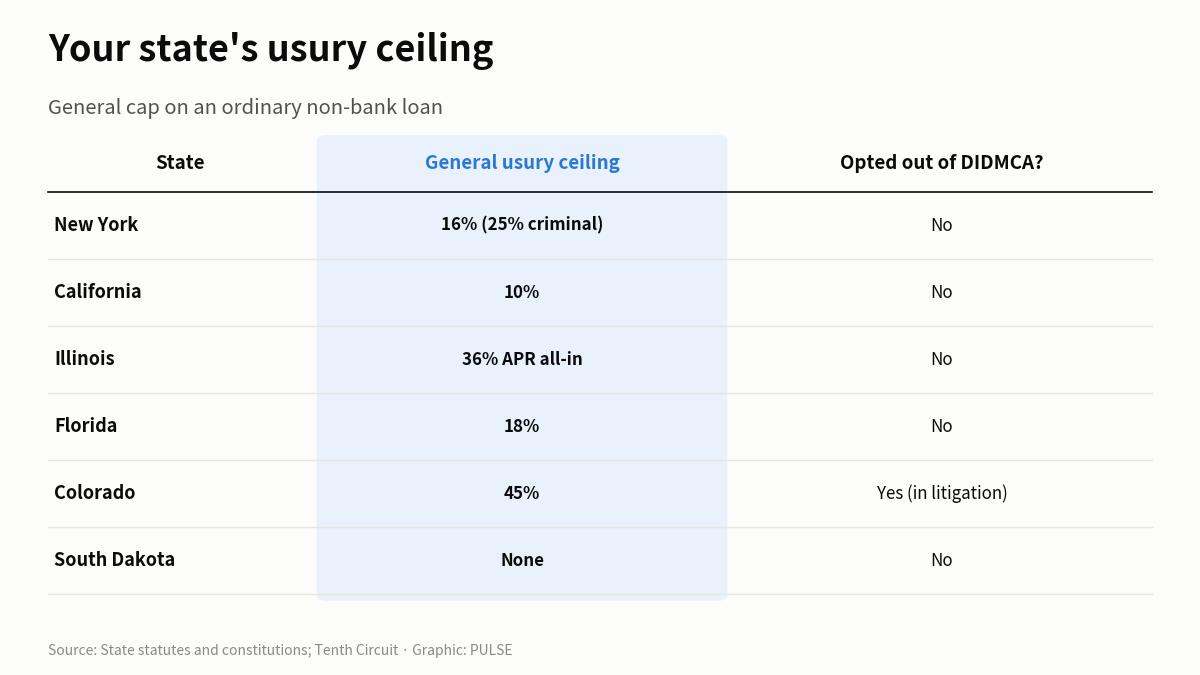
If you sign a loan this week, the most a lender can legally charge you is not a national figure. It is a number written into your own state's code. In New York that number is 16 percent on an ordinary loan. In South Dakota there is no number at all when the rate is set in writing. A bill now moving through the U.S. House would change how much your state's number is worth.
Here is the part most borrowers miss. Your state cap already does not bind every lender. A 1980 federal law lets a bank charge the rate allowed in the state where the bank sits, even to a customer who lives somewhere stricter. The argument over H.R. 7866 is an argument over the one tool states kept to push back.
The ceiling in your state's code, and who it really binds
Usury caps read as single, clean percentages, but they split by loan size, loan type, and who is doing the lending. A general ceiling usually covers an ordinary written loan between people or from an unlicensed lender. Licensed finance companies, pawnbrokers, and banks each sit under their own chapters, often with higher limits or none.
The spread across states is wide. New York sets civil usury at 16 percent and makes charging more than 25 percent a felony. California's constitution caps ordinary consumer loans at 10 percent. Florida sets 18 percent on loans up to $500,000. Illinois takes a different route, capping almost every consumer loan at a flat 36 percent, all fees included. Colorado's general contract ceiling runs all the way up to 45 percent, though its consumer-credit code holds everyday lenders far below that.
Why a loan in a capped state can still carry a triple-digit rate
The gap between your state's number and your actual bill comes from a federal statute, the Depository Institutions Deregulation and Monetary Control Act of 1980. Under its Section 521, a state-chartered bank may charge the interest rate allowed in its home state and export that rate to borrowers nationwide, per the California attorney general's account of the law.
That is how a lender partnered with a bank in a no-cap state can offer a loan to a resident of a capped state at a rate the capped state would otherwise forbid. Consumer advocates call the arrangement rent-a-bank. The counterweight Congress built in is Section 525, which lets a state opt out of the preemption for loans made in its borders.
What H.R. 7866 would take off the table
H.R. 7866, the American Lending Fairness Act of 2026, was introduced by Representative Warren Davidson of Ohio, according to the bill record at GovInfo. Its stated aim is to let a state's opt-out reach only loans made by banks that state itself chartered, not out-of-state banks lending in.
The eighteen attorneys general who oppose it, led by Oregon's Dan Rayfield and joined by California's Rob Bonta, read that as gutting the opt-out. Their letter says the bill would strip states of the ability to enforce usury caps against out-of-state banks and would, in their words, rob state legislatures of this important right. The signers include Arizona, Colorado, Connecticut, Hawaii, Illinois, Maine, Maryland, Massachusetts, Michigan, Minnesota, Nevada, New Jersey, New York, Virginia, Washington, and the District of Columbia.
The bill is not law. The House Financial Services Committee advanced it on September 16, 2026, by a vote of 31 to 18, as reported by the Consumer Finance Monitor, a law firm publication we cite here because the committee's own tally sheet was not posted on an official page we could reach. A full House vote has not happened.
How six states' ceilings compare
The table below shows each state's general usury ceiling, the figure that governs an ordinary loan from a non-bank lender, alongside whether the state has invoked its Section 525 opt-out. Treat the ceiling as a starting point, not a promise. Licensed lenders and banks frequently operate above it, and in states with no cap there is no legal ceiling to begin with.
| State | General usury ceiling | Opted out of DIDMCA? |
|---|---|---|
| New York | 16% (25% criminal) | No |
| California | 10% | No |
| Illinois | 36% APR all-in | No |
| Florida | 18% | No |
| Colorado | 45% | Yes (in litigation) |
| South Dakota | None | No |
Colorado shows why the single number can mislead. Its general contract ceiling is 45 percent, yet the state passed a 2023 law invoking the opt-out so it could apply its lower consumer-credit caps to out-of-state banks lending to Colorado residents. Those consumer caps sit near 21 percent for a state-bank loan, far under the 45 percent headline.
Colorado is the live test, and a court just reopened it
Colorado's opt-out is being fought in the Tenth Circuit. A three-judge panel sided with the state on November 10, 2025, reading the statute's phrase about loans made in the state to cover loans where either the lender or the borrower sits there. Then the full court granted an en banc rehearing and vacated that panel ruling, according to the Consumer Financial Services Law Monitor, a firm blog we cite because the court's docket is not freely searchable. So the reach of an opt-out, the very thing H.R. 7866 would narrow, is unsettled even in the states that have one.
What to check before you sign, and what to watch in Congress
Before you borrow, find the lender's name and its chartering state in the loan agreement, not the marketing page. If the money comes through a bank based in a no-cap state like South Dakota, your own state's ceiling may not protect you today, opt-out or not. Pull your state's usury statute and read which lenders it exempts; the exemptions matter more than the headline rate.
In Washington, watch for a floor vote on H.R. 7866 and any Senate companion. In the courts, watch the Tenth Circuit's en banc decision in the Colorado case, which will tell you how far a state opt-out can stretch. If you think a rate broke your state's law, your state attorney general's consumer office is the place to report it.
How we checked this
We read the bill record for H.R. 7866 on GovInfo and the California attorney general's November 10, 2026 press release describing the coalition letter and the DIDMCA mechanics. We confirmed state ceilings on official pages where we could reach them: New York Banking Law Section 14-a and Penal Law 190.40 on the New York Senate site, California's constitution on the attorney general's site, Florida Statutes 687.03 on the Florida Senate site, and the South Dakota statute heading on the state legislature site. The official Colorado and Illinois statute pages and the Illinois attorney general PDF would not load or parse, so we relied on compiled-statute reproductions for the 45 percent Colorado figure and the 36 percent Illinois figure and say so here. We could not reach the Texas statute portal, so Texas is not in the table. The committee vote and the Tenth Circuit history come from law firm publications, attributed in the text, because the official records were not reachable. Checked November 12, 2026. Spot an error? Write to connect@blinkhub.net.