By September 28, the number ofnamed stormsin the region had grown to 20, of which nine had reached hurricane strength.
For comparison, the 1991-2020 average by that date is 13.5 named storms with 7.4 hurricanes.
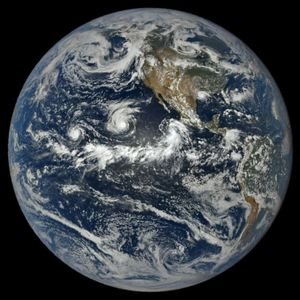
An image from NASA’sEPIC on theDSCOVR satellite, acquired on September 27, shows the basinagainrife with powerful storms.
Hurricane Nolo near Hawaii and Hurricane Polo off the Baja California peninsula were lashing land with high winds, storm surge, and heavy rain.
On either side of Polo, Tropical Storm Rachel and Post-Tropical Cyclone Odalys were contributing to treacherous conditions along the Mexican coast and in the southwestern U.S., respectively.
Hurricane Polo made landfall in Baja California Sur around 11 p.m. local time on September 28.
Before encountering land, the storm had undergoneextreme rapid intensificationwhile churning over theunusually warmocean surface, catapulting to category 5 status on September 22.
Polo waned in intensity on its approach to the coast and likely made landfall as a category 2 storm, according to the National Hurricane Center.
Polo then continued across the peninsula and the Gulf of California and made asecond landfall, near Guaymas, as a further weakened system around midday on September 29.
The NHC warned of dangerous winds and storm surge, as well as heavy rains capable of triggering flooding and mudslides in parts of Baja California Sur and Sonora.
The hurricane’s effects were expected to be even more widespread.
Polo and its remnants, combined with moisture from Post-Tropical Cyclone Odalys, were likely to push over the southwestern U.S. and southern Plains over several days, forecasters said, fueling yet moreheavy rainand flood risk.
Next in the train of storms, Tropical Storm Rachel was tracking parallel to the southwest Mexico coast, where theNHC forecaststrong winds and dangerous surf and rip current conditions.
Meanwhile, the third hurricane of the season to pass close to Hawaii was delivering yet another deluge to the islands.
Hurricane Nolo, though it did not make landfall, dropped more than12 inches of rain on parts of Maui and the Island of Hawai‘i.
The storm flooded roads, toppled trees, and triggered landslides, according tonews reports, but the Island of Hawai‘i was spared some of the more severe effects wrought byHurricane Lalain mid-August.
As of September 28, theaccumulated cyclone energyin the Northeast Pacific was more thantwice the norm, according todata from Colorado State University.
Scientists expect an increase in tropical cyclone activity in this ocean basin during anEl Niño, which has beenunderwaysince June.
Warm water in the equatorial Pacific and lowwind shearin the region, both typical El Niño patterns, encourage tropical storms to develop and strengthen.
TheNASA Disasters Program, in coordination with FEMA, is supporting the State of Hawaii’s response to Hurricane Nolo.
The team will be posting maps and data products on its open-accessmapping portalas new information becomes available.
NASA Earth Observatory images by Lauren Dauphin, using data fromDSCOVR EPICandVIIRS data from NASA EOSDISLANCE,GIBS/Worldview, and the Suomi National Polar-orbiting Partnership. Story by Lindsey Doermann.
JPEG
Colorado State UniversityReal-Time Northeast Pacific Ocean Statistics by Storm for 2026. Accessed September 29, 2026.
Honolulu Civil BeatPhoto Essay: Hurricane Nolo Spares Hawai‘i The Worst Of Its Wrath. Accessed September 29, 2026.
NASA Earth ObservatoryExplosive Intensification for Hurricane Polo. Accessed September 29, 2026.
NASA Earth ObservatoryA Trio of Tropical Cyclones in the Pacific. Accessed September 29, 2026.
National Hurricane CenterHurricane NOLO Advisory Archive. Accessed September 29, 2026.
National Hurricane CenterHurricane POLO Advisory Archive. Accessed September 29, 2026.
The Washington PostHurricane Polo remnants to bring serious flood threat to Southwest, central U.S. Accessed September 29, 2026.
Yale Climate ConnectionsHurricane Nolo takes another turn, Polo to bring deep tropical moisture to Southwest desert. Accessed September 29, 2026.
Stay up-to-date with the latest content from NASA as we explore the universe and discover more about our home planet.
The powerful storm delivered extreme rainfall and damaging winds to the state, passing the Island of Hawai‘i as a category…
Several ingredients came together off the Pacific coast of Mexico to generate one of the strongest storms the eastern Pacific…
The Pacific was buzzing with storms while the Atlantic was notably quiet.
Subscribe to the Earth Observatory and get the Earth in your inbox.
NASA’s Earth Observatory brings you the Earth, every day, with in-depth stories and stunning imagery.
Explore Earth Science
Open access to NASA’s archive of Earth science data