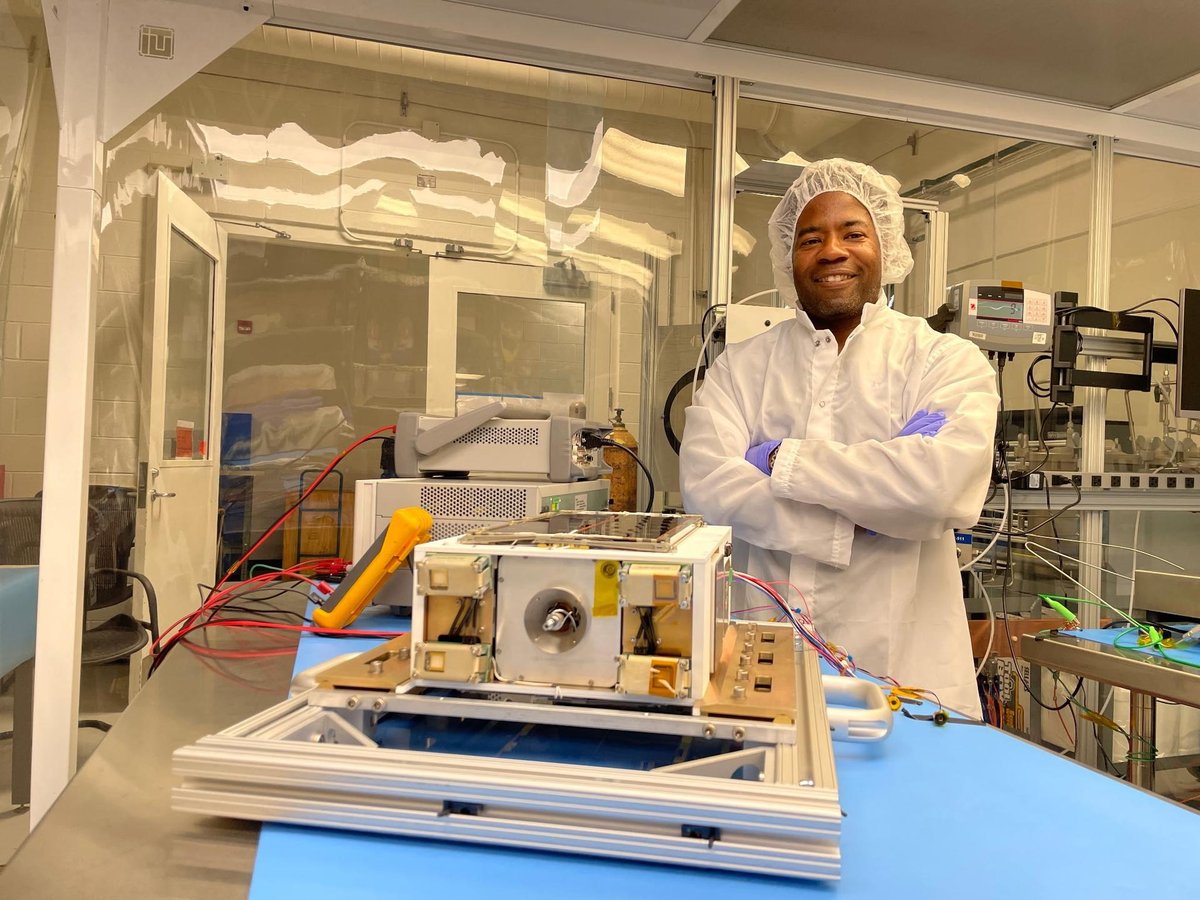
NASA has completed testing on a new small spacecraft designed to demonstrate a hybrid propulsion system that could reduce weight and costs for future space missions, the agency said.
The ASCENT Propulsion Dual Mode spacecraft, about the size of a large shoebox, underwent environmental and physical testing at NASA's Marshall Space Flight Center in Huntsville, Alabama, before its scheduled October launch. The system integrates a high-thrust chemical engine and low-thrust electric thrusters fed by a single tank of non-toxic propellant, eliminating the need for separate fuel systems and heavy plumbing currently required on most spacecraft.
Traditionally, spacecraft carry two propulsion systems: a powerful chemical system for rapid maneuvers like entering orbit, and a low-thrust electric system for slower, more fuel-efficient tasks. The single-system approach saves critical mass and volume, allowing more room for scientific instruments and enabling launches on smaller, less expensive rockets, NASA said.
The engineering team at Marshall subjected the flight hardware to rigorous testing. Engineers performed pressurized helium leak tests inside a vacuum chamber to verify the integrity of the spacecraft's seals and fuel lines. The spacecraft also underwent thermal vacuum testing to ensure its electronics, thrusters, and mechanical systems would operate normally in the harsh conditions of space. Additional testing included a spin test to verify the spacecraft's balance and center of gravity.
"There are a lot of odds and ends, and a lot of small challenges and some big ones," said Nehemiah Williams, the mission's project manager at NASA Marshall. "But ensuring the functionality of the propulsion system across all these different teams is what makes the mission successful."
The ASCENT mission is set to launch no earlier than October 1 as a payload aboard a SpaceX Falcon 9 rocket from Vandenberg Space Force Base in California. Once in orbit about 325 miles above Earth, the spacecraft will conduct a nine-month mission testing the dual-mode concept, executing both chemical and electric maneuvers to prove the system works in space.
The project brought together teams across the country, with MIT developing the electrospray thrusters, Plasma Processes building the chemical propulsion module, and Georgia Institute of Technology integrating the spacecraft. NASA Marshall managed the overall mission.